8 Reasons Why You Should Install a Heat Pump
Learn about the advantages of owning a heat pump and how its innovative technology will save you money and ensure your comfort.

The Benefits of a Heat Pump:
8 Reasons Why You Should Install a Heat Pump
“A heat pump is expensive; I can’t afford it.”
“A heat pump is not efficient in Quebec’s extreme cold.”

If these two arguments come to mind, you’re not the only one. 90% of homeowners who need to replace their furnace hesitate to buy a heat pump for similar reasons.
Many years ago, these arguments may have been valid. Many things have changed since then, including the cost and efficiency of the system.
 Reason #1
Financial Assistance is Available
The cost of a heat pump has greatly reduced since it first went on the market. What’s more, several grants are now available to help cover their cost.
For the most up-to-date information on available heat pump grants in Quebec, visit our dedicated article Save Money and Energy: Government Heat Pump Grants in Quebec.
Reason #2
Compatible with Existing Ducts

Do you already have existing ductwork in your home?
Central heat pump systems are compatible with existing ducts. An inspection of your ductwork will be conducted to ensure that your new heating system will be working as efficiently as possible.
Reason #3
Heat Pumps are Eco-friendly
Not only do heat pumps help you save money, but they’re also environmentally friendly. Oil and propane furnaces use non-renewable resources, while heat pumps use electricity. In Quebec, electricity is a renewable and eco-friendly source of energy.
Furthermore, heat pumps use the R-410 refrigerant, which doesn’t harm the ozone layer.
Look for Energy Star models, the government-backed symbol for energy efficiency.

Reason #4
Covered by Great Warranties

Quality warranties are available for heat pumps. A 10 year limited warranty on parts and labour is available for most models.
Some companies offer a limited lifetime warranty on the compressor, and extended warranties are also available at a fair price.
Reason #5
Enjoy Impressive Savings
Choosing a heat pump as your main heating system translates into significant cost and energy savings. Heat pumps harness the ambient air’s heat, a free, renewable energy source that decreases your electricity consumption.
Heat pumps don’t create heat but transfer heat from the air outside into the home. It’s estimated that at an exterior temperature of 8 °C, each watt of electricity releases 3 watts of heat into your home. That gives you two watts for free!

A 2011 study shows the annual heating costs of a 2 500 foot square home in Montreal,depending on the heating system:
| Inverter Heat Pump | $1 341 |
| Natural Gas | $3 159 |
| Electricity | $3 212 |
| Propane Gas | $6 159 |
Numbers don’t lie. Since heat pumps release more energy than they use, you get more comfort at a smaller cost.
Reason #6
Experience Optimal Comfort

A heat pump cools your home in summer and heats it in winter. With a heat pump, your home is at the optimal temperature all year round!
Since air is pushed inside the home and circulates, you’re comfortable no matter where you are.
Some models of heat pumps control up to 8 interior units. Each room’s temperature can be adjusted for optimal comfort according to its occupants’ preferences.
Homes equipped with a heat pump contain fewer allergens since the air is filtered before entering the house.
Reason #7
Heat Pumps are Quiet
Most heat pumps are so quiet that you’ll barely notice they’re running. An inverter system’s interior units make no more noise than a light rainfall. When working at low capacity, they make even less noise.
Here’s a list of everyday sounds and the decibels they emit compared to an inverter heat pump:
| Interior unit | 19 dB |
| Exterior unit | 46 dB |
| Rustling leaves | 20 dB |
| A whisper | 30 dB |
| A bird chirping | 44 dB |
| Conversation | 60 dB |
| An alarm clock | 80 dB |

Reason #8
They’re Very Efficient

Modern heat pumps offer high-performance, even in Quebec’s extreme cold.
Some models remain highly efficient in temperatures as low as -30 °C.
In Quebec, a heat pump’s COP (coefficient of performance) varies between 1.4 and 3.3, depending on the exterior temperature. That means that a heat pump delivers more energy than it consumes. That’s efficiency at its best!
Learn More About the Heat Pump:
What is the Coefficient of Performance (COP)?
Definition
The coefficient of performance (COP) indicates how much heat is delivered for each energy unit consumed. It is a ratio. For example, a COP of 4 means that four heat units are delivered for each unit of energy, or electricity consumed. The higher the COP, the better its energy efficiency.
Energy Transfer
How can a heat pump create more energy than it uses? According to the laws of physics, it’s impossible. As explained earlier, heat pump systems don’t produce heat but gather the energy from exterior air and transfer it inside your home. Transferring thermal energy from one place to another requires a lot less energy than creating it.
Let’s illustrate with an example:
A heat pump uses 1 000 watts of electricity to absorb 3 000 watts of exterior heat. The 1 000 watts of electricity used to gather the external heat are converted into heat, which added to the 3 000 watts, makes 4 000 watts total. In conclusion, 1 000 watts of electricity delivered 4 000 watts of heat.

To help you visualize the energy efficiency of various heating systems, here’s a list of their coefficients of performance:
| Air-source heat pump (with an exterior temperature of -8.3 °C) | 2.3 |
| Air-source heat pump (with an exterior temperature of 10 °C) | 3.3 |
| Oil furnace | 0.95 |
| Electric baseboard heaters and convectors | 1 |
| High-performance gas furnace | 0.95 |
| Forced-air heating system | 1 |
The colder it is outside, the lower the heat pump’s COP. In Quebec, a heat pump’s coefficient of performance varies between 1.4 and 3.3, depending on the exterior temperature. The heat pump is much more efficient than any other system.
The Different Technologies of the Heat Pump
A central heat pump’s compressor can be one of 3 different types.
To find which compressor will best meet your needs, here are their main characteristics:
Single Stage Compressor
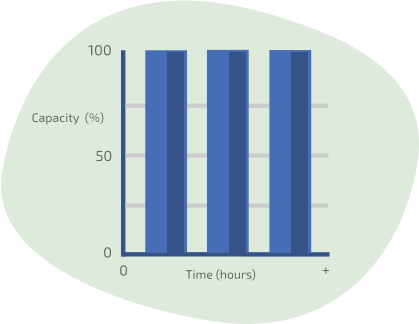
Single stage compressors always work at 100% of their capacity, consuming more energy than other models. These conventional devices work in on/off mode. Efficient in temperatures of -12 °C and warmer.
- Purchase cost: low
- Efficiency: low to moderate
- Operating cost: average to high
Two Stage Compressor
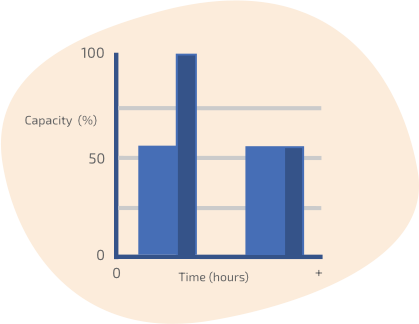
Two stage compressors work at two capacity levels, which are generally 67% and 100%. When working at a capacity of 67%, the compressor is in “maintenance” mode, which means it consumes less energy since it’s only maintaining the room’s temperature. Efficient in temperatures of -20 °C and warmer.
- Purchase cost: average
- Efficiency: moderate to high
- Operating cost: low to average
Inverter System
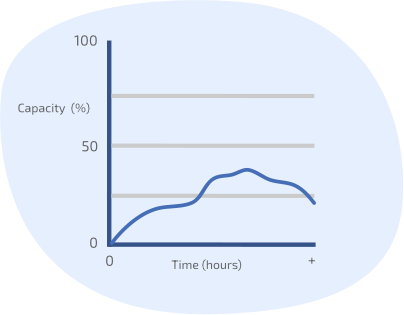
Inverter systems work somewhat like dimmable lightbulbs, varying between a capacity of 30% and 100%, depending on the demand. The system detects any change in the room temperature and adjusts the compressor and fan speed accordingly, which gives a more consistent ambient temperature. At low speed, the heat pump works longer but uses a lot less energy. Exceptional performance for temperatures as low as -30 °C.
- Purchase cost: high
- Efficiency: excellent
- Operating cost: low
These three types of central heat pump systems are sturdy, durable and reliable. They ensure optimal comfort in your home throughout the seasons.
There are also other kinds of heat pumps, such as the wall-mounted heat pump that doesn’t require ductwork, the concealed-ceiling heat pump, the 4 way cassette indoor unit, the floor-mounted heat pump, and the multi-zone system. Not sure which model is best for you? MST’s team will be more than happy to help you find the perfect unit for your home.
How to Choose Your Contractor
Choosing the right heat pump system is extremely important, but choosing the right contractor is just as crucial.
A qualified contractor with the appropriate license will install your heat pump according to the manufacturer’s norms, resulting in optimal performance.
To be eligible for financial assistance, the removal and installation of your new heating unit must be carried out by qualified contractors with the appropriate RBQ licenses.

Make an Informed Choice According to Your Needs
Many factors can affect your choice of heat pump. Contact MST to be sure you select the model best adapted to your home and needs..
MST is an RBQ license holder and owns a CMEQ license as an electrical contractor. Each member of our technical team is also licensed in their field.
On our first visit, our experts will evaluate your home, the number of floors, the ceiling height, quality of the insulation, and more, to determine which heat pump will bring you maximum comfort.
When choosing a heat pump, you can expect:
- consistent temperatures
- increased air quality
- cost reductions
- a quiet, reliable, eco-friendly system
A heat pump is a choice you won’t regret!
